Neon Void

Concept · Interaction Design · Motion · Web
Year
'26
Role
Concept · Interaction Design · Motion · Web
Tools
Midjourney · Firefly · GSAP · Vercel
A fictional cyberpunk game, built to answer one question: can a single interaction carry a whole site?
Self-initiated concept
Challenge
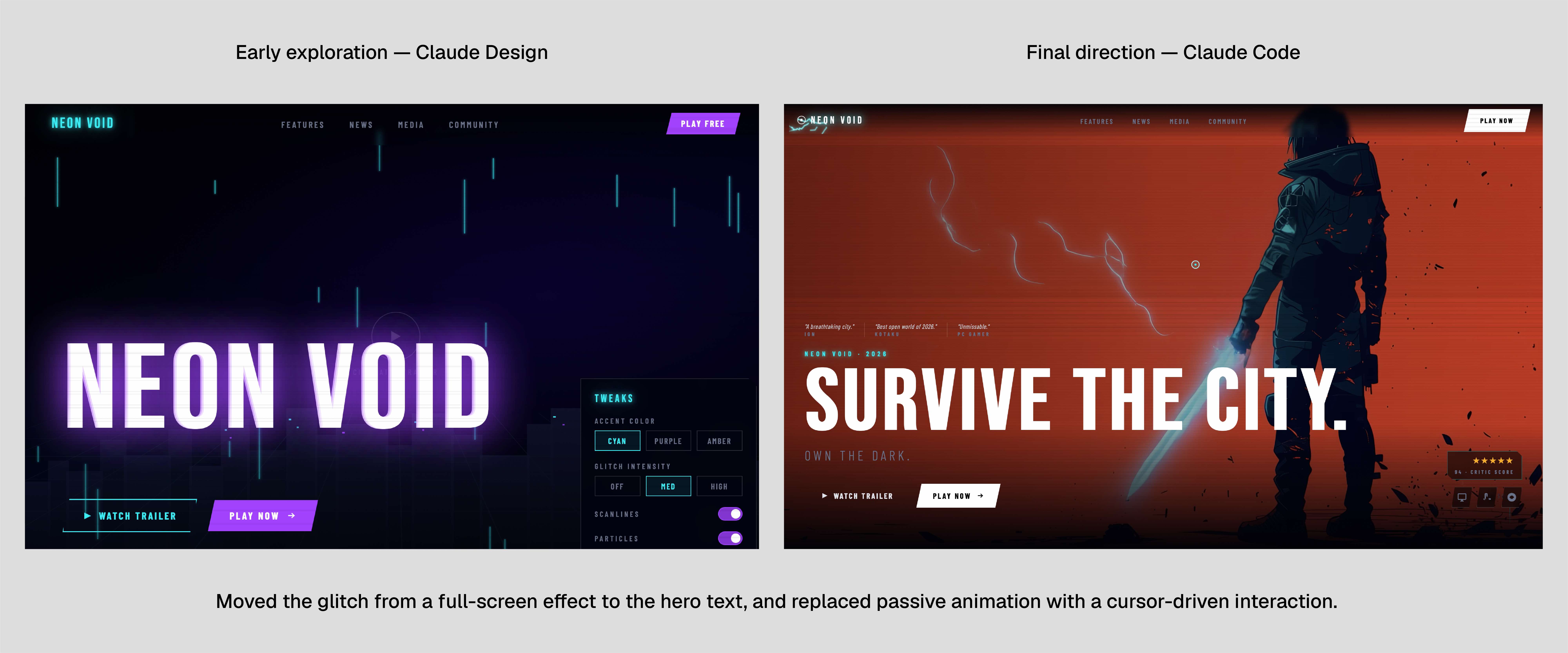
The starting point was Cyberpunk 2077’s site — a piece I’d long admired. But its hero is essentially static, alive only through a glitch pass. For a game, that felt like a missed beat: players expect to act, not watch. I kept the glitch and asked a different question — what would the hero feel like if it answered your cursor? The sword should follow your hand, and reaching the top should do something, not just sit there.
Approach
Move your cursor and the blade rises and falls with it. When the sword reaches the top, electricity discharges across the logo — the motion you’re driving resolves into the brand mark. It’s GSAP mapping cursor position to video frames, so the scrub feels physical instead of triggered.
Tweaks panel
A Tweaks panel sits in the corner: swap the accent between cyan, purple, and amber, push glitch intensity from off to high, toggle the scanlines. The whole site re-themes live. It began as a way to test the visual system and stayed because it lets a visitor make the world their own.

Worldbuilding
Around the interaction is a complete game world — Neo-Kyoto, a 40km² megacity with its own factions, critic quotes, patch notes, and a studio that doesn’t exist. The fiction is built out far enough to be convincing. Characters and environments came from Midjourney, refined in Firefly; the build is vanilla JS and GSAP — no framework — directed in Claude Code and deployed on Vercel.


Outcome
There’s no launch metric here — it’s a concept. What it proves is the part that matters: an interaction smooth enough to ship, inside a world cohesive enough to believe.
The cursor-scrubbing hero is the kind of thing most concept sites only mock up. This one is live, and it holds up on a trackpad.
Challenge
The starting point was Cyberpunk 2077’s site — a piece I’d long admired. But its hero is essentially static, alive only through a glitch pass. For a game, that felt like a missed beat: players expect to act, not watch. I kept the glitch and asked a different question — what would the hero feel like if it answered your cursor? The sword should follow your hand, and reaching the top should do something, not just sit there.
Approach
Move your cursor and the blade rises and falls with it. When the sword reaches the top, electricity discharges across the logo — the motion you’re driving resolves into the brand mark. It’s GSAP mapping cursor position to video frames, so the scrub feels physical instead of triggered.
Tweaks panel
A Tweaks panel sits in the corner: swap the accent between cyan, purple, and amber, push glitch intensity from off to high, toggle the scanlines. The whole site re-themes live. It began as a way to test the visual system and stayed because it lets a visitor make the world their own.
Worldbuilding
Around the interaction is a complete game world — Neo-Kyoto, a 40km² megacity with its own factions, critic quotes, patch notes, and a studio that doesn’t exist. The fiction is built out far enough to be convincing. Characters and environments came from Midjourney, refined in Firefly; the build is vanilla JS and GSAP — no framework — directed in Claude Code and deployed on Vercel.
Outcome
There’s no launch metric here — it’s a concept. What it proves is the part that matters: an interaction smooth enough to ship, inside a world cohesive enough to believe.
The cursor-scrubbing hero is the kind of thing most concept sites only mock up. This one is live, and it holds up on a trackpad.
2025
New Zealand Naturals: Frozen Yogurt Bars
Interaction & Motion Design