Ryse Therapy

Brand identity · Web · Interaction
Year
'26
Role
Brand Identity, UX, Visual Design, Web Design, Build
Tools
Figma · Claude · Claude Code · Midjourney · Adobe Firefly · Vercel · GitHub
Ryse Therapy is a Seattle telehealth practice. The project was a full brand identity and a four-page website built to make reaching out for therapy feel less daunting — warm, human, and calming rather than clinical.
A calm, dandelion-led identity system carried across brand, copy, and a custom-built site.
Challenge
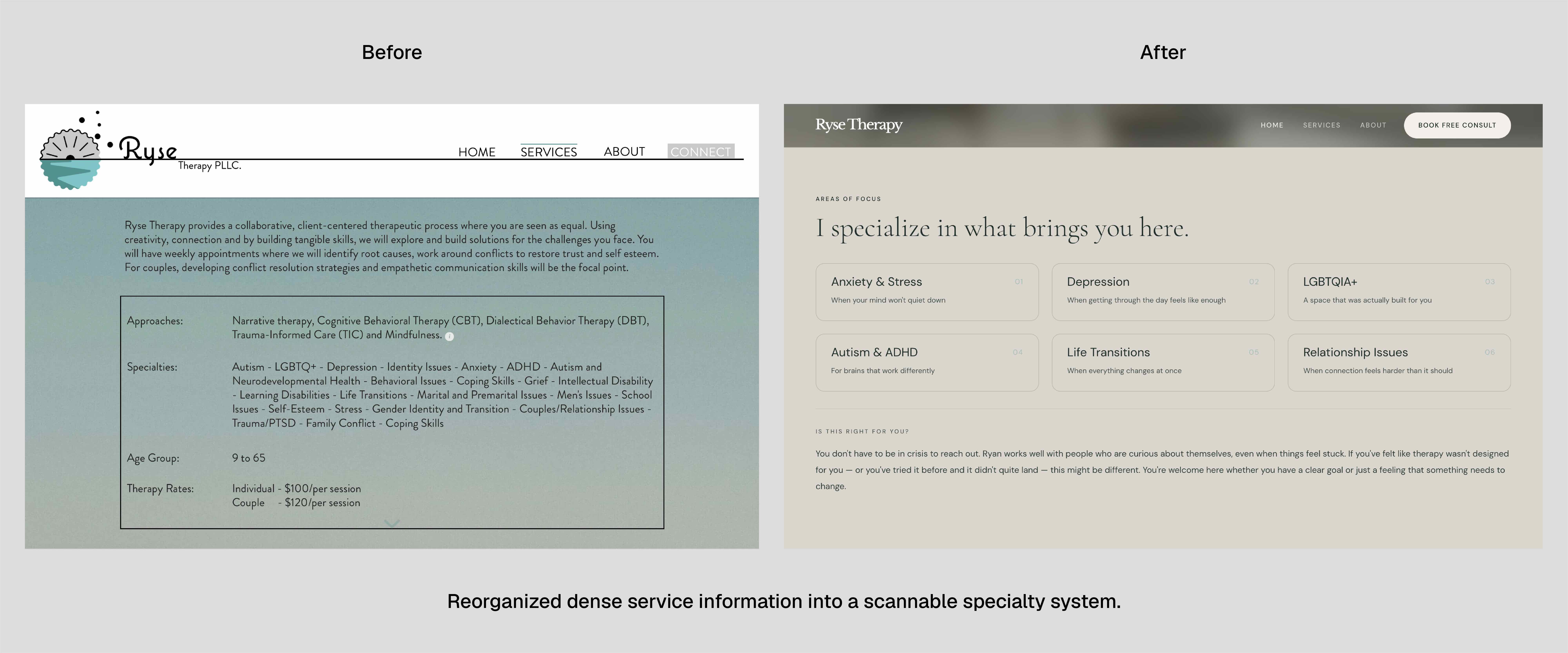
The practice was running on an inherited template site that felt generic and impersonal, the opposite of how Ryse actually works with clients. It didn't communicate warmth, didn't establish trust, and gave first-time visitors no sense of the person behind the practice.
The goal was to make the single most intimidating action feel safe: reaching out for the first time. That meant designing for an anxious first-time visitor, not just a polished homepage.
Before / After — Homepage

Approach
The work ran in two arcs: first a brand and content foundation, then a custom-built site that turned that foundation into an experience. Every creative decision stayed human-led; AI handled the friction of production.
The website experience and transformation remain the emphasis; process artifacts support the story without taking over the page.

01 · Brand & wordmark
The identity centers on a dandelion — letting go, growth, resilience — paired with a calm teal-and-cream palette and an italic Cormorant Garamond display face reserved for emotional, voice-led moments. Italic carries feeling; roman handles function. The wordmark went through repeated reduction to land on something quiet and confident rather than decorative.

02 · Information architecture & content
Before any UI, the site was reduced to four pages — Home, Services, About, Privacy — mapped to how an anxious visitor actually moves: is this person safe → what do they treat → can I trust them → how do I start. Copy was rewritten throughout to be plain, warm, and reassuring, replacing clinical language with the way Ryan actually speaks.

Information Architecture Diagram

03 · UI & atmosphere
The site is built as one cinematic, scroll-driven world: a parallax sky-and-city hero, hard horizontal color cuts between sections, and a 3D dandelion that drifts and morphs as you scroll. Motion is used sparingly — enough to feel alive and calming, never distracting from the message.

Design System Snapshot


Business Card / Brand Collateral

Responsive Design

Final experience across desktop and mobile viewports.
04 · AI-Assisted Build
The site is vanilla HTML, CSS, and JS with no framework, built through a directed AI workflow: design decisions made in conversation, turned into precise prompts, executed by Claude Code, then reviewed screenshot-by-screenshot on a live URL. Midjourney generated the hero cloud imagery; Adobe Firefly produced the dandelion and CTA video. The role here was director — prompting, judging, and deploying.

Directed AI build workflow
Outcome
The result is a live site that reframes a clinical template as a calm, human first impression — clear about who Ryan is, what he treats, and how to begin. The brand system — type, color, the dandelion motif, the voice — extends cleanly across the site, business cards, and a campaign kit.
Beyond the deliverable, the project demonstrates an end-to-end modern workflow: brand thinking, IA, content strategy, UI, and an AI-assisted design-to-deploy pipeline owned by one person.
Challenge
The practice was running on an inherited template site that felt generic and impersonal, the opposite of how Ryse actually works with clients. It didn't communicate warmth, didn't establish trust, and gave first-time visitors no sense of the person behind the practice.
The goal was to make the single most intimidating action feel safe: reaching out for the first time. That meant designing for an anxious first-time visitor, not just a polished homepage.
Before / After — Homepage
Approach
The work ran in two arcs: first a brand and content foundation, then a custom-built site that turned that foundation into an experience. Every creative decision stayed human-led; AI handled the friction of production.
The website experience and transformation remain the emphasis; process artifacts support the story without taking over the page.
01 · Brand & wordmark
The identity centers on a dandelion — letting go, growth, resilience — paired with a calm teal-and-cream palette and an italic Cormorant Garamond display face reserved for emotional, voice-led moments. Italic carries feeling; roman handles function. The wordmark went through repeated reduction to land on something quiet and confident rather than decorative.
02 · Information architecture & content
Before any UI, the site was reduced to four pages — Home, Services, About, Privacy — mapped to how an anxious visitor actually moves: is this person safe → what do they treat → can I trust them → how do I start. Copy was rewritten throughout to be plain, warm, and reassuring, replacing clinical language with the way Ryan actually speaks.
Information Architecture Diagram
03 · UI & atmosphere
The site is built as one cinematic, scroll-driven world: a parallax sky-and-city hero, hard horizontal color cuts between sections, and a 3D dandelion that drifts and morphs as you scroll. Motion is used sparingly — enough to feel alive and calming, never distracting from the message.
Design System Snapshot
Business Card / Brand Collateral
Responsive Design
Final experience across desktop and mobile viewports.
04 · AI-Assisted Build
The site is vanilla HTML, CSS, and JS with no framework, built through a directed AI workflow: design decisions made in conversation, turned into precise prompts, executed by Claude Code, then reviewed screenshot-by-screenshot on a live URL. Midjourney generated the hero cloud imagery; Adobe Firefly produced the dandelion and CTA video. The role here was director — prompting, judging, and deploying.
Directed AI build workflow
Outcome
The result is a live site that reframes a clinical template as a calm, human first impression — clear about who Ryan is, what he treats, and how to begin. The brand system — type, color, the dandelion motif, the voice — extends cleanly across the site, business cards, and a campaign kit.
Beyond the deliverable, the project demonstrates an end-to-end modern workflow: brand thinking, IA, content strategy, UI, and an AI-assisted design-to-deploy pipeline owned by one person.
2025
Dishpig
ALIF